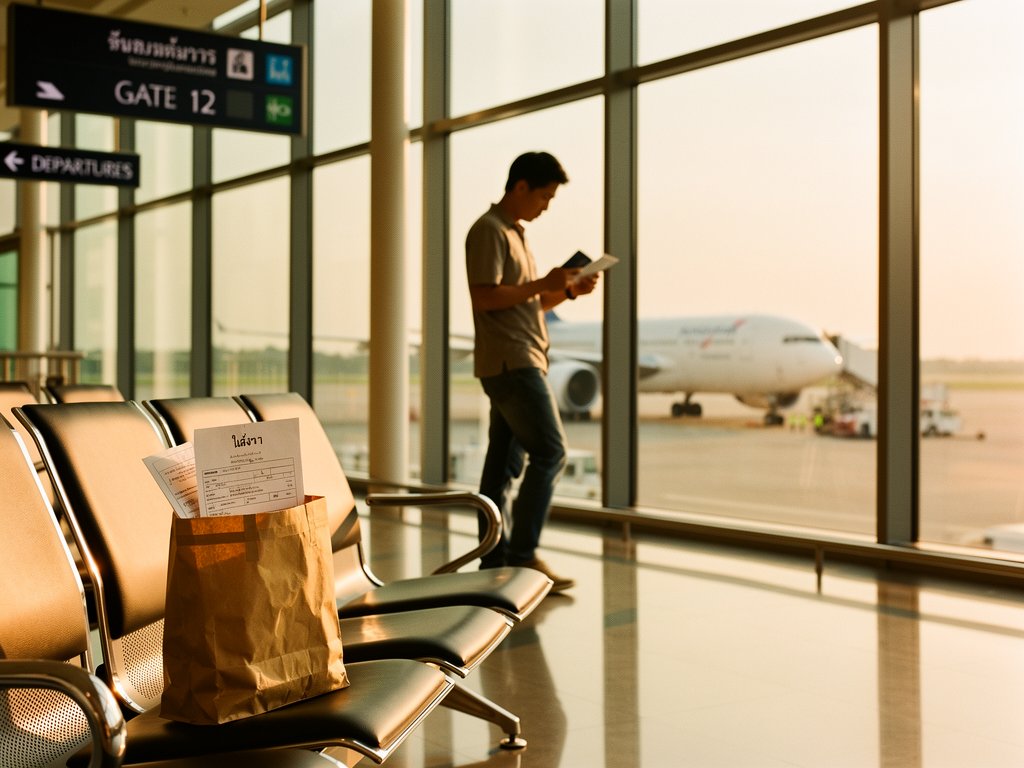
You can transport prescribed cannabis within Thailand, including on domestic flights (Bangkok to Chiang Mai, Phuket to Bangkok, any flight that takes off and lands on Thai soil), if you carry a valid PT 33 prescription and stay within the quantity it allows. Without one, possessing cannabis flower is illegal anywhere in the country, airports included.
International flights are a different matter entirely. Carrying cannabis on any flight leaving Thailand is a serious criminal offence, whatever your prescription says and whatever the law says at your destination. That rule has no exceptions.
This guide covers the domestic rules as they stand in 2026: the documents you need, how to pack, what enforcement looks like, and where each Thai airline actually stands once you read its own published rules — Bangkok Airways, Thai Airways, Thai AirAsia, Nok Air, Thai Vietjet, and Thai Lion Air. For the carrier-by-carrier detail, including the exact pages we checked, see our flying with cannabis in Thailand hub.
The Short Version
You can carry medical cannabis on domestic flights within Thailand if you hold a valid PT 33 prescription from a licensed Thai practitioner. Without that prescription, possessing cannabis flower is illegal, with commonly reported penalties of up to 25,000 THB in fines and three months in prison.
Pack it in your checked bag. Carry your prescription. Do not spend time hunting for your airline’s cannabis policy — no Thai carrier publishes one, in either direction. That covers about 90% of what most people need to know.
How We Got to This Point
When Thailand decriminalized cannabis in June 2022, the Airports of Thailand (AOT) confirmed that passengers over 20 could carry cannabis on domestic flights with essentially no restrictions. There was no weight limit. The only rule was the standard 100ml liquid restriction for carry-on items (Coconuts Bangkok, June 2022).
That changed on 26 June 2025, when a Ministry of Public Health notification signed by Public Health Minister Somsak Thepsuthin was published in the Royal Gazette with immediate effect, reclassifying cannabis flower as a controlled herb (สมุนไพรควบคุม) under the Traditional Medicine Act B.E. 2542 (1999) (The Nation, June 2025).
Cannabis flower was not returned to the narcotics list. It sits in a distinct legal category — controlled herb — which means different rules and different penalties than narcotics offences. One exception matters for travellers: cannabis and hemp extracts above 0.2% THC remain Category 5 narcotics under a separate regulation, a harsher regime than the controlled-herb rules covering flower. But the practical effect for everyone was immediate: you now need a medical prescription to legally possess cannabis flower anywhere in Thailand, including airports.
What You Need to Fly With Cannabis
A Valid PT 33 Prescription
The PT 33 form (ใบสั่งยา ปท. 33) is Thailand’s official medical cannabis prescription. It must come from one of seven categories of licensed practitioners, all of whom must hold cannabis-prescribing certification from the Department of Thai Traditional and Alternative Medicine (DTAM) (Tilleke & Gibbins, 2026):
- Medical doctors
- Thai traditional medicine practitioners
- Applied Thai traditional medicine practitioners
- Traditional Chinese medicine practitioners
- Pharmacists
- Dentists
- Licensed folk healers
Each prescription is valid for a maximum of 30 days and is non-refillable. You need a new consultation for each new prescription. Foreign medical cannabis cards and prescriptions from other countries have no legal validity in Thailand (Terms.Law, 2026).
If you are a tourist, walk-in cannabis clinics in Bangkok, Chiang Mai, Phuket and other major cities can issue a PT 33 in about 30 minutes. See our guide to choosing a cannabis clinic and our clinic directory. Flying out of the capital? Our medical cannabis in Bangkok guide covers getting a prescription there before your flight.
Your Purchase Receipt
Keep the receipt from your licensed dispensary. It provides a paper trail linking your cannabis to a legal purchase under a valid prescription. Some travellers also carry a photo of the dispensary’s licence on their phone, though this is not strictly required.
Packing: Checked Baggage vs. Carry-On
Put it in your checked bag. This is not a legal requirement, but it is a strong practical recommendation from AOT itself.
Here is why: cannabis carried through the security checkpoint in your hand luggage triggers an inspection by staff from the Narcotics Control Board (ปปส., Office of the Narcotics Control Board). AOT does not have the authority to verify THC percentages, so the ONCB gets involved. That means delays — potentially significant ones — while your products are tested or reviewed (Coconuts Bangkok, June 2022).
In checked luggage, your cannabis goes through standard screening without triggering the same inspection process.
Liquid Products
Cannabis in liquid form — tinctures, oils — follows the same 100ml carry-on restriction that applies to all liquids. If you are checking the bag, the 100ml limit does not apply, but the liquid must contain less than 0.2% THC unless it is covered by your PT 33 prescription.
Edibles and Extracts
This is where things get difficult. AOT has acknowledged that secondary cannabis products like edibles, hashish, and concentrated oils are problematic because airport security cannot test THC content on the spot. And the legal stakes are higher: extracts above 0.2% THC are Category 5 narcotics under the Narcotics Code, not controlled herbs. If your product contains more than 0.2% THC and you do not have a prescription covering it, you are taking a serious risk.
Flower with a valid prescription is the safest option for domestic travel.
CBD Products
CBD products with less than 0.2% THC do not require a prescription and can be carried on domestic flights without any special documentation. These are treated like any other legal consumer product.
Cannabis Policies by Airline: What the Carriers Actually Publish
Most travel articles will tell you that Thai Airways and Bangkok Airways ban cannabis and that AirAsia allows it with a PT 33. On 28 July 2026 we went to the airlines’ own published rules to check, and none of that is written down anywhere.
We read the current prohibited-items, restricted-baggage and dangerous-goods pages of all six Thai carriers operating scheduled domestic flights. Not one of them mentions cannabis, marijuana, กัญชา, hemp or narcotics. Their lists are the standard ICAO and IATA dangerous-goods classes — explosives, gases, flammable liquids, oxidisers, toxic and infectious substances, radioactive material, corrosives, lithium batteries — plus each carrier’s own commercial restrictions.
| Airline | Publishes a cannabis policy? | What its pages do say |
|---|---|---|
| Thai Airways | No | Standard ICAO dangerous-goods categories; no cannabis entry, checked or carry-on |
| Bangkok Airways | No | 15 categories of prohibited items; cannabis is not one of them |
| Thai AirAsia | No | No cannabis entry in its dangerous-goods provisions; dedicated prohibited-items article could not be retrieved |
| Nok Air | No | Standard dangerous-goods list, plus a baggage-search clause |
| Thai Vietjet | No | Standard dangerous-goods and baggage pages; no cannabis clause |
| Thai Lion Air | No | Dangerous-goods provisions name no cannabis; carriage may be refused to comply with applicable law |
Per-carrier detail, with the exact URLs we checked, lives on our flying with cannabis in Thailand hub and the individual airline pages linked from it.
What “No Published Policy” Actually Means
An airline that has never written a cannabis clause has not given you permission. It has left the question to the law and to its general right to refuse carriage. Three separate parties decide whether your cannabis travels:
- Thai law. Since 26 June 2025, cannabis flower is a controlled herb (สมุนไพรควบคุม) under the Traditional Medicine Act B.E. 2542 (1999), and possessing it lawfully requires a valid PT 33 prescription. That applies inside an airport exactly as it applies on the street.
- Airport security and the police. The screening officer at the checkpoint is not an airline employee. Cannabis found in baggage is handled under Thai law, which in practice can mean a referral to narcotics officers for verification.
- The airline. Every carrier’s conditions of carriage reserve a right to refuse a passenger or baggage where refusal is necessary to comply with applicable law, and a right to search baggage. Thai Lion Air words it as refusing carriage where “such action is necessary in order to comply with any applicable laws, regulations or orders of any state or country to be flown from, into or over.” The others use materially similar language.
Bangkok Airways
Full detail: Bangkok Airways cannabis policy. Bangkok Airways publishes a prohibited-items page listing 15 categories of restricted articles. Cannabis is not among them, and the airline publishes no cannabis clause elsewhere. The claim that Bangkok Airways bans cannabis outright — repeated across cannabis blogs for years — cannot be traced to any Bangkok Airways source.
This still matters for one route in particular. Bangkok Airways operates Samui Airport, so if you are flying to Koh Samui you are almost certainly flying Bangkok Airways. Carry a valid PT 33 and your dispensary receipt, and treat the checkpoint rather than the airline as the thing to prepare for.
Thai Airways (Including Former Thai Smile Routes)
Full detail: Thai Airways prohibited items and cannabis. Thai Airways publishes no cannabis rule in either direction. Its dangerous-goods and restricted-baggage pages list the standard categories and stop there — no prohibition on cannabis in checked or carry-on baggage, and no permission either.
A note on Thai Smile: it is no longer a carrier. Thai Smile Airways flew its last services at the end of 2023 and was merged into Thai Airways, which absorbed the aircraft, routes and forward bookings. A search for a Thai Smile cannabis policy is really a question about Thai Airways.
Thai AirAsia
Full detail: Thai AirAsia cannabis policy. Thai AirAsia’s dangerous-goods provisions contain no cannabis entry. Its dedicated prohibited-items article renders client-side, so we could not retrieve its contents on 28 July 2026 — we are telling you that rather than guessing at what it says.
What we can say is that the widely circulated claim that “AirAsia allows medical cannabis with a valid PT 33” is unverifiable. It traces back to cannabis blogs, not to an AirAsia page, and we found nothing on AirAsia’s own site that states it. Do not book on the strength of it. If you need certainty, ask AirAsia in writing, quote your flight number, and keep the reply with your prescription.
Nok Air, Thai Vietjet and Thai Lion Air
None of the three publishes a cannabis-specific policy — but neither does any other Thai carrier, so this is not a reason to prefer one airline over another. Their dangerous-goods pages list the standard ICAO classes; Nok Air also publishes a baggage-search clause, and Thai Lion Air’s terms of carriage reserve the right to refuse carriage where necessary to comply with applicable law.
Key point: an airline refusal is not a legal penalty, but it can mean surrendering your cannabis at the airport or being denied boarding. Because no carrier has published a rule, the variable you can actually control is your paperwork — a valid PT 33 and the dispensary receipt.
What Happens If You Get Caught Without a Prescription
Since the June 2025 regulatory change, the penalties depend on the specific offence — and the figures come from two different statutes, so keep them straight:
- Possessing cannabis flower without a valid PT 33: commonly reported penalties of up to 25,000 THB (roughly $700 USD) in fines and up to 3 months imprisonment (ThaiLawOnline, 2026)
- Smoking in public or creating a nuisance (the smell counts): fines up to 25,000 THB and/or up to 3 months under the Public Health Act B.E. 2535 (1992) — a separate offence that happens to carry the same headline figure
- Selling cannabis without a prescription (the shop’s offence, not the buyer’s): up to 1 year imprisonment and/or a 20,000 THB fine under the Traditional Medicine Act B.E. 2542 (1999) (Legal500, 2025)
- For foreign nationals: deportation and a criminal record that can affect future visa applications
Police have been actively checking prescriptions at airports, dispensaries, and popular tourist areas since the new rules took effect (AllAboutLawyer, 2026).
This is not theoretical. Enforcement is active and ongoing.
The One Rule That Has Not Changed: Never Fly International
Carrying cannabis on any international flight departing Thailand is a serious criminal offence. This was true in 2022 and it remains true now. The Food and Drug Administration has been unambiguous: importing “any cannabis or hemp, in any form” into or out of Thailand is forbidden.
It does not matter if cannabis is legal at your destination. The moment you cross an international border with Thai cannabis, you are committing a crime under both Thai law and likely the laws of your destination country.
This applies to connecting flights as well. If your itinerary involves an international leg, leave your cannabis behind.
Practical Checklist Before You Fly
- Get your PT 33 prescription from a licensed Thai practitioner — budget 30 minutes at a walk-in clinic
- Keep your dispensary receipt with the cannabis
- Do not rely on second-hand airline “policies” — no Thai carrier publishes a cannabis rule, in either direction (see the per-airline detail)
- Get written confirmation from the carrier if you want airline-level certainty — a written reply is the only assurance that exists
- Pack cannabis in checked luggage to avoid ONCB inspection delays at security
- Carry your PT 33 in your wallet or carry-on for easy access if asked
- Keep liquids under 100ml if carrying cannabis tinctures in hand luggage
- Never, under any circumstances, fly international with cannabis
Looking Ahead
Thailand’s Cannabis and Hemp Act (พ.ร.บ. กัญชา กัญชง) has still not passed. The Ministry of Public Health ran a formal public consultation on the draft from 22 April to 21 May 2026, and the government has said it wants the Act passed before the end of 2026, though that timeline is uncertain (DeeMED, June 2026).
Until then, ministerial regulations govern. Two landed this spring: the Category 5 extract regulation, effective 26 April 2026, and Ministerial Regulation No. 2 B.E. 2569 on controlled herbs, published in the Royal Gazette on 30 April 2026 (Juslaws, 2026). Both tighten licensing for cannabis businesses. Neither changed the rules for passengers carrying prescribed cannabis on domestic flights.
We will update this guide as the legal landscape develops. For the full picture on current regulations, see our Thailand cannabis laws 2026 guide.
Last verified: 28 July 2026 — airline positions checked directly against each carrier’s own published prohibited-items and dangerous-goods pages. This article is for informational purposes only and does not constitute legal advice. Cannabis regulations in Thailand change frequently. Always verify current rules before travelling.
Frequently Asked Questions
Can you bring cannabis on a domestic flight in Thailand?
Can you transport cannabis within Thailand with a prescription?
Should you pack cannabis in checked or carry-on luggage?
How much cannabis can you take on a Thai domestic flight?
Do all Thai airlines allow cannabis on board?
What is Bangkok Airways' cannabis policy?
Does Thai Airways allow cannabis in checked luggage?
Does AirAsia Thailand allow medical cannabis with a PT 33?
Can you fly Nok Air, Thai Vietjet, or Thai Lion Air with cannabis?
Can you take cannabis on an international flight from Thailand?
Cannabis for Thailand
Cannabis for Thailand