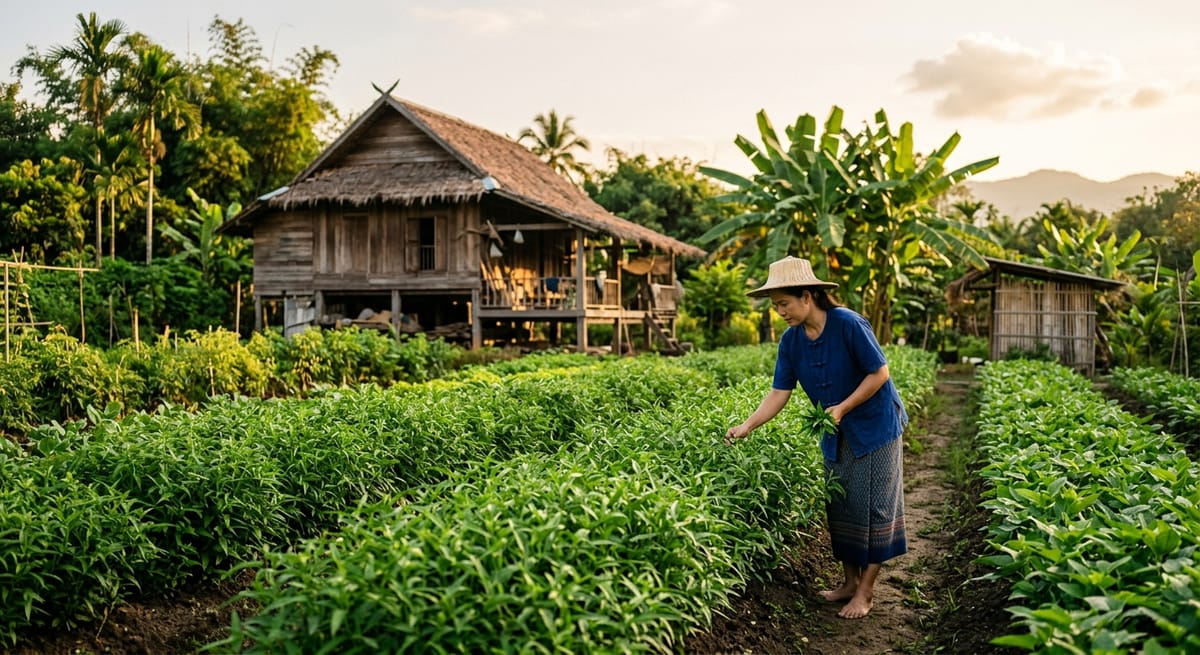
Thailand made history in June 2022 as the first Asian country to decriminalize cannabis. Since then, a thriving cultivation industry has emerged — and then transformed. Following the June 2025 reclassification of cannabis flower as a “controlled herb,” the farming landscape has shifted from a recreational free-for-all to a regulated, medical-focused agricultural sector.
Whether you are a Thai farmer considering cannabis as a crop, a community enterprise planning a cultivation project, or an international investor exploring opportunities, this guide covers everything you need to know about legally growing cannabis in Thailand in 2026.
Can You Grow Cannabis in Thailand? The Short Answer
Yes — cultivation is still lawful, and it is still not a narcotics offence. But it is licensed activity, and the informal 2022–2024 version of it is gone.
Cannabis flower is a controlled herb under the Traditional Medicine Act, not a Category 5 narcotic, so growing it sits under the traditional-medicine and herbal-products regime rather than the Narcotics Code. What changed after 26 June 2025 is the purpose: cultivation is now oriented to medical and traditional-medicine supply, and the licensed clinics you would sell to must source flower from GACP-certified farms.
Growing without the applicable licence is not a grey area. The rest of this guide covers which licence applies to you, what certification you need, and what it costs to get there.
Current Legal Framework for Cannabis Cultivation
The June 2025 Reversal
On 26 June 2025, a proclamation signed by then–Public Health Minister Somsak Thepsuthin was published in the Royal Gazette with immediate effect, reclassifying cannabis flower buds (ช่อดอก) as a “controlled herb” under the Protection and Promotion of Thai Traditional Medicine Knowledge Act B.E. 2542 (1999). This effectively ended the open recreational market and repositioned cannabis cultivation as a medical and traditional medicine activity. The current Public Health Minister, Pattana Promphat, has since extended the framework with the two April 2026 ministerial regulations described below. For full details on the current legal framework, see our Thailand Cannabis Laws 2026 guide.
Key point: Cannabis flower is not reclassified as a narcotic under the Narcotics Act. This is a legally significant distinction — cannabis farming remains legal, but under a stricter regulatory framework focused on medical applications.
The Cannabis and Hemp Act — Still Unpassed (2026)
The Cabinet approved a draft Cannabis and Hemp Act (ร่าง พ.ร.บ.กัญชา กัญชง) on June 24, 2025. The Ministry of Public Health opened formal public consultation on the current draft from 22 April through 21 May 2026. As of September 2026 the Act has not passed parliament. Until passage, current regulations operate under a layered framework of ministerial regulations, FDA rules, and existing pharmaceutical laws rather than a single dedicated cannabis statute.
Two further ministerial regulations took effect in April 2026 that directly affect cultivators and processors:
- Extracts above 0.2% THC — Ministerial Regulation on the production, import, export, sale or possession of Category 5 narcotics specifically cannabis or hemp extracts B.E. 2569 (2026) — Royal Gazette 26 March 2026, effective 26 April 2026. Restricts use to four permitted purposes (medical, research, industrial, narcotics suppression) and excludes foreign-owned entities. Old 2020–2021 licences valid only until 31 December 2026.
- Cannabis-flower licensing — Ministerial Regulation (No. 2) B.E. 2569 — Royal Gazette 30 April 2026. Adds four cumulative criteria for sell/process/export licences: premises ownership, dedicated storage, health-sector qualifying credential, DTAM-trained staff, plus odor/smoke elimination. Cultivators selling to Section 46 buyers fall within scope at the buyer’s licensing point.
The combined effect is a tighter closed-loop system: cultivators may sell only to other licensees, and licensed sellers and processors must source from GACP-compliant producers with appropriate qualifying credentials.
What This Means for Farmers
- Cannabis cultivation is legal with proper licensing and registration
- All cannabis flower produced must be directed toward medical and traditional medicine channels
- Community enterprises remain the primary pathway for cultivation
- Security, tracking, and quality standards are mandatory
- The market has contracted but stabilized around medical demand
Who Can Grow Cannabis in Thailand
Thai Nationals and Households
Thai citizens can cultivate cannabis at home after registering through the “Pluk Kan” (ปลูกกัญ) app or the Thai FDA website. However, household cultivation is subject to plant limits and purpose restrictions. Home-grown cannabis flower cannot be sold commercially without proper licensing.
Community Enterprises (วิสาหกิจชุมชน)
Community enterprises are the most common and accessible pathway for cannabis farming in Thailand. This model was designed to ensure that economic benefits flow to local Thai communities rather than large corporations.
Requirements to form a cannabis community enterprise:
- Minimum 7 members from the same district, each from a different household registration
- Register with the district agriculture office — site inspection occurs within 7-15 days
- Partner with a government agency — typically a provincial health promotion hospital, university, or government department
- Sign a Memorandum of Agreement (MOA) — not merely an MOU; this is a binding partnership
- Complete at least 2 training sessions on cannabis cultivation and regulations
- Register cultivation with the FDA via the Pluk Kan system
Important restriction: Under the community enterprise model, all flower buds must be sent to the Department of Thai Traditional Medicine for pharmaceutical extraction. Community enterprises may commercially use stems, roots, branches, and leaves, but cannot sell flower buds directly.
Commercial Companies
Private companies can obtain cultivation permits under Section 46 of the relevant pharmaceutical regulations. This covers research, processing, export preparation, and distribution. Requirements include:
- Thai-registered company structure
- GACP (Good Agricultural and Collection Practices) certification
- Full compliance with DTAM standards
- Detailed cultivation, processing, and distribution plans
Foreign Nationals
Foreigners cannot directly hold cannabis cultivation licenses in Thailand. The regulatory framework strongly favors Thai nationals and Thai-registered entities. However, foreign participation is possible through:
- Thai-majority joint ventures where Thai partners hold the cultivation license
- BOI (Board of Investment) registered companies for agricultural technology and processing — see our cannabis business guide for more on licensing options
- Advisory and technology partnerships with licensed Thai operators
- Investment in processing and value-added operations rather than direct cultivation
During the initial 5-year period following decriminalization (2022-2027), cultivation is restricted to partnerships involving government agencies or community enterprises working with the government.
Licensing and Registration Process
Step 1: FDA Registration
All cannabis cultivators must register with the Thai Food and Drug Administration (FDA). Registration is done through the Pluk Kan (ปลูกกัญ) system — either the mobile app or the web portal at cannabisinfo.fda.moph.go.th.
Registration requires:
- Thai national ID or company registration documents
- GPS coordinates of the cultivation site
- Cultivation plan detailing strains, quantities, and intended use
- Security plan for the facility
Step 2: GACP Certification
The Department of Thai Traditional and Alternative Medicine (DTAM) requires Good Agricultural and Collection Practices (GACP) certification under Thai or EU standards.
GACP certification covers:
- Environmental monitoring — soil, water, and air quality records
- Cultivation inputs — fertilizers, pesticides (organic preferred), growing media
- Employee hygiene — training, protective equipment, sanitation protocols
- Harvest procedures — timing, handling, drying, and curing standards
- Batch tracking — complete seed-to-sale traceability
- Quality testing — cannabinoid profiles, contaminant screening
Certification must be renewed every 3 years.
Step 3: Security Compliance
Cannabis farms must implement physical security measures:
- Concrete perimeter fencing with barbed wire or equivalent barriers
- CCTV camera system covering all cultivation and storage areas
- Security personnel during operating hours
- Access control — visitor logs, restricted entry zones
- Inventory tracking — daily plant counts, weight records
Step 4: Ongoing Compliance
Licensed cultivators must maintain:
- Monthly transaction records using official forms (Phor.Tor.27, 28, 29)
- Harvest and distribution logs submitted to DTAM
- Quality testing results for each batch
- Annual license renewal documentation
Cannabis vs Hemp: Understanding the Distinction
Thailand maintains a clear legal distinction between cannabis (กัญชา) and hemp (กัญชง), and this distinction significantly affects what you can grow and sell.
| Factor | Cannabis (กัญชา) | Hemp (กัญชง) |
|---|---|---|
| THC Content | Above 0.2% in extracts | Not exceeding 1.0% by dry weight |
| Legal Status | Controlled herb (flower buds) | Permitted for industrial and commercial use |
| Regulation | Under traditional medicine framework | Lighter regulatory pathway |
| Market Access | Medical dispensaries only | Food, textiles, cosmetics, construction |
| Flower Sales | Requires PT 33 prescription | Less restricted |
| Export | Licensed pathway only (Ministerial Reg. No. 2 B.E. 2569, GACP required) | Limited pathways for CBD products |
Why Hemp May Be the Better Opportunity
For many farmers, hemp cultivation offers a more straightforward business model:
- Broader market access — hemp products can be sold as food ingredients, textiles, construction materials, cosmetics, and wellness products without medical restrictions
- Lower regulatory burden — fewer security requirements and simpler licensing
- Industrial applications — hemp blocks (40% lighter than regular building blocks), hemp boards (20% lighter than MDF), bioplastics, and fiber products
- CBD extraction — hemp-derived CBD products (under 0.2% THC) are a growing market
- Food products — hemp seeds, hemp seed oil, and hemp protein are increasingly popular in Thai and export markets
Costs: Starting a Cannabis Farm in Thailand
Small Farm (Outdoor/Greenhouse, Under 1 Rai)
| Cost Category | Estimated Cost (THB) |
|---|---|
| Land lease (annual) | 30,000 - 80,000 |
| Greenhouse structure (50 plants) | 100,000 - 200,000 |
| Security (CCTV, fencing) | 50,000 - 100,000 |
| Seeds/clones | 10,000 - 30,000 |
| Growing supplies (soil, nutrients, pots) | 20,000 - 50,000 |
| Licensing and registration | 10,000 - 30,000 |
| Total startup | 200,000 - 500,000 |
| USD equivalent | $5,500 - $14,000 |
Medium Farm (Greenhouse, 1-5 Rai)
| Cost Category | Estimated Cost (THB) |
|---|---|
| Land lease or purchase | 200,000 - 1,000,000 |
| Greenhouse/structure (100+ plants) | 500,000 - 2,000,000 |
| Irrigation and climate control | 200,000 - 500,000 |
| Security infrastructure | 150,000 - 400,000 |
| Seeds, clones, and genetics | 50,000 - 150,000 |
| Staff (first year) | 300,000 - 600,000 |
| Licensing, legal, compliance | 50,000 - 150,000 |
| Total startup | 1,000,000 - 5,000,000 |
| USD equivalent | $28,000 - $140,000 |
Large Indoor Commercial Operation
| Cost Category | Estimated Cost (THB) |
|---|---|
| Facility build-out | 5,000,000 - 20,000,000 |
| Climate control (HVAC, dehumidification) | 2,000,000 - 10,000,000 |
| Lighting systems | 1,000,000 - 5,000,000 |
| Security (commercial grade) | 500,000 - 2,000,000 |
| Genetics program | 200,000 - 1,000,000 |
| Staffing (first year) | 1,000,000 - 3,000,000 |
| Laboratory and testing | 500,000 - 2,000,000 |
| Legal and compliance | 200,000 - 500,000 |
| Total startup | 10,000,000 - 50,000,000+ |
| USD equivalent | $280,000 - $1,400,000+ |
Open-Field Hemp Cultivation
Hemp farming has lower startup costs:
- Small-scale hemp: From 20,000 THB per rai (~$570 USD)
- Commercial hemp operation: 300,000 - 1,500,000 THB per rai depending on processing capabilities
- Typical payback period: 4-5 years
Revenue Potential
Cannabis
- Flower yield: Approximately 500 grams per plant per cycle
- Growing cycles: 2 per year (5-6 months each)
- Cannabis oil (closed-system extraction): 100,000+ THB per kilogram
- Cannabis oil (open-system extraction): 50,000-70,000 THB per kilogram
- Leaf sales to processors: Approximately 15,000 THB per kilogram
Hemp
- CBD isolate/extract: Premium pricing for pharmaceutical-grade material
- Hemp seed products: Growing domestic and export demand
- Industrial fiber: Steady demand for textiles and construction
- Food-grade hemp: Emerging market in health food retail
Revenue Reality Check
Important caveats for any cannabis farming business plan:
- Only about half of registered cultivators actually proceed with growing due to investment risk
- The medical-only market is significantly smaller than the previous open market
- Market access — having confirmed buyers before investing is essential
- Price compression has occurred as the market matures
- Community enterprise flower buds must go to DTAM, limiting direct sales revenue
Best Regions for Cannabis Farming in Thailand
Northern Thailand (Chiang Mai, Chiang Rai, Lampang)
Advantages:
- Ideal climate — cooler temperatures and lower humidity at elevation
- Strong agricultural tradition and skilled labor
- Active cannabis farming community
- Highland Research and Development Institute support for hemp
- Tourist market proximity for dispensary partnerships
Best for: Outdoor and greenhouse cultivation, premium flower, hemp
Isan / Northeast (Buriram, Nakhon Ratchasima, Mahasarakham)
Advantages:
- Lower land and labor costs
- Established community enterprise network
- Government support programs — Mahasarakham developed a “Cannabis Model” for community integration
- Agricultural infrastructure already in place
Best for: Community enterprise farming, large-scale hemp, cost-efficient production
Kanchanaburi
Advantages:
- Active cannabis farming hub — 8 community enterprises in operation
- Proven track record (200 kg medical cannabis harvested in early batches)
- Proximity to Bangkok markets
- Favorable growing conditions
Best for: Community enterprise cannabis, medical supply chain
Central Thailand and Bangkok Surroundings
Advantages:
- Proximity to processing facilities, labs, and distributors
- Access to skilled technical staff
- Closer to export infrastructure (Suvarnabhumi, Laem Chabang port)
- Urban market access for dispensary partnerships
Best for: Indoor commercial operations, processing, value-added products
Southern Thailand (Phuket, Krabi, Surat Thani)
Advantages:
- Strong tourist market for dispensary sales
- Year-round warm climate
- Emerging farm-to-dispensary supply chains
Challenges: Higher humidity requires more climate control; higher land costs in tourist areas
Best for: Boutique farms supplying tourist-area dispensaries
How to Start a Cannabis Farm: Step-by-Step
Phase 1: Planning (2-3 Months)
- Research your model — community enterprise, commercial company, or hemp operation
- Choose your region based on climate, costs, and market access
- Secure land — lease or purchase with proper zoning for agriculture
- Identify your market — which dispensaries, processors, or distributors will buy your product
- Build your team — at minimum you need a cultivation manager, compliance officer, and security
Phase 2: Legal Setup (2-4 Months)
- Register your entity — community enterprise at the district agriculture office, or company at the DBD
- Secure government partnership (for community enterprises) — approach provincial health hospitals or universities
- Sign MOA with your government partner
- Complete required training — minimum 2 certified courses
- Register cultivation on the Pluk Kan system
- Apply for GACP certification from DTAM
Phase 3: Build-Out (2-6 Months)
- Install security infrastructure — perimeter fencing, CCTV, access control
- Build cultivation facility — greenhouse, indoor grow room, or prepare outdoor plots
- Set up irrigation and climate control
- Source genetics — seeds or clones from approved suppliers
- Prepare growing media — soil, coco coir, or hydroponic systems
- Complete GACP inspection and certification
Phase 4: First Cultivation Cycle (5-6 Months)
- Germination and seedling stage — 2-4 weeks
- Vegetative growth — 4-8 weeks depending on strain and method
- Flowering — 8-12 weeks depending on strain
- Harvest, drying, and curing — 2-4 weeks
- Quality testing — cannabinoid profiles, contaminant screening
- Distribution — to DTAM (for community enterprise flower) or licensed buyers
Total Timeline: 12-18 Months from Decision to First Harvest
Thai Cannabis Strains and Genetics
Thailand has a rich cannabis genetic heritage. Thai landrace sativas are legendary in the global cannabis world and offer unique advantages for local cultivation.
Thai Landrace Varieties
- Thai Stick — the original Thai sativa that became famous worldwide in the 1970s. Long flowering time (14-20 weeks) but produces distinctive, aromatic flower
- Thai Sativa — various regional landrace genetics adapted to Thailand’s tropical climate over centuries. Naturally resistant to local pests and mold
- Highland Thai — genetics from northern mountain regions, slightly shorter flowering times
Modern Genetics in Thailand
Many Thai farms also grow modern hybrid strains that offer:
- Shorter flowering times (8-10 weeks vs 14-20 for pure Thai sativas)
- Higher yields per plant
- More consistent cannabinoid profiles
- Better suitability for indoor cultivation
Seed Sourcing
Seeds and clones should be sourced from:
- Registered Thai seed banks and nurseries
- Government research institutions
- Established cannabis farms with breeding programs
- Licensed importers (with proper documentation)
Organic Cannabis Farming in Thailand
Thailand’s tropical climate and agricultural traditions make it well-suited for organic cannabis cultivation. Organic practices are increasingly valued in the medical cannabis market.
Soil Preparation
Thailand’s diverse soil types affect cannabis cultivation differently:
- Laterite soils (common in the northeast) — need organic matter amendments
- Alluvial soils (river basins, central plains) — naturally fertile, excellent for cannabis
- Sandy loam (coastal areas) — good drainage, may need nutrient supplementation
- Mountain soils (north) — often rich in organic matter, ideal for outdoor growing
Organic Pest Control
Thailand’s tropical environment means year-round pest pressure. Effective organic solutions include:
- Neem oil — broad-spectrum organic pesticide effective against most cannabis pests
- Beauveria bassiana — beneficial fungus that controls whiteflies, thrips, and aphids
- Bacillus thuringiensis (Bt) — biological control for caterpillars and larvae
- Predatory insects — ladybugs, lacewings, and predatory mites
- Companion planting — basil, marigolds, and lemongrass as natural pest deterrents
GAP and Organic Certification
While not mandatory, Good Agricultural Practices (GAP) certification is strongly encouraged and can command premium prices. Organic certification through Thai standards or international bodies (USDA Organic, EU Organic) adds further market value, particularly for export-oriented CBD and hemp products.
Export Regulations
Cannabis Flower
Cannabis flower may only leave Thailand under an export license for controlled herbs issued under Ministerial Regulation No. 2 B.E. 2569 (2026), and exported flower must be GACP-certified. Exporting without that license is a criminal offence under the controlled-herb framework — do not attempt it.
CBD and Hemp Products
Hemp-derived products with less than 0.2% THC have limited export pathways:
- Requires FDA export approval
- Destination country compliance verification
- Pharmaceutical-grade documentation
- Batch testing and certificates of analysis
Thailand is actively developing its position as a CBD exporter. The National Nanotechnology Center (NANOTEC) has developed nanoparticle CBD delivery technology to enhance the value and effectiveness of export products. However, the export infrastructure remains in development.
Import
Cannabis import into Thailand is strictly prohibited under all circumstances.
Market Outlook: Cannabis Farming in 2026 and Beyond
The Contraction
The Thai cannabis market has undergone significant contraction since the June 2025 regulatory changes:
- 18,433 shops at peak → 11,136 still operating (May 2026)
- 8,636 licenses expired in 2025; only 1,339 (15.5%) renewed
- Roughly half of the ~12,000 licenses currently valid are reported to expire in 2026 (Bangkok Post; unverified)
- Each renewal now triggers full re-qualification under the April 30, 2026 four-criteria framework
- The market is consolidating around serious, compliant operators
Opportunities
Despite the contraction, significant opportunities remain:
- Medical cannabis supply — demand from clinics and hospitals continues to grow as more practitioners become certified
- CBD and wellness products — the fastest-growing segment, no prescription required
- Hemp industrial products — construction materials, textiles, bioplastics — emerging sector with government support
- Cannabis tourism — Thailand remains a destination for medical cannabis access, supporting farm-to-dispensary supply chains
- Processing and extraction — value-added manufacturing has higher margins than raw cultivation
- Research partnerships — universities and government agencies actively seek cultivation partners
Risks
- Regulatory uncertainty — the Cannabis and Hemp Act has not yet passed; final regulations could change requirements
- Market oversupply — flower prices have compressed as cultivation expanded faster than medical demand
- Enforcement changes — increased scrutiny and compliance requirements expected
- Political shifts — cannabis policy remains politically sensitive in Thailand
- Foreign ownership restrictions — limit direct investment from international cannabis companies
Cannabis Farms in Thailand
Thailand’s licensed farms range from seven-member community enterprises to GACP-certified commercial operations and hemp growers. The landscape is shifting fast as licenses come up for renewal under the stricter 2026 rules — if you are planning to enter the sector, start with the licensing pathway in our cannabis license guide.
Farms by Region
- Bangkok and Central Thailand — indoor and greenhouse operations
- Chiang Mai and Northern Thailand — outdoor, greenhouse, and highland farms
- Isan (Northeast) — community enterprise farms around Buriram, Khon Kaen and Korat
- Southern Thailand — boutique farms serving tourist markets
Our cannabis farm directory lists farms by province. A directory entry is not proof of GACP certification; ask for the certificate before buying or partnering.
Conclusion
Cannabis farming in Thailand in 2026 is a legitimate agricultural activity operating under a medical framework. The days of unregulated cultivation are over, but the opportunities for compliant, well-planned farming operations are real.
The most successful farms will be those that:
- Secure licensing and GACP certification before investing in infrastructure
- Build market relationships with dispensaries, processors, and medical channels before first harvest
- Choose the right model — community enterprise for accessibility, commercial license for scale
- Consider hemp as a potentially more profitable and less restricted alternative
- Plan for the long term — the regulatory framework will continue evolving as the Cannabis and Hemp Act progresses through parliament
Thailand’s cannabis farming industry is maturing. For farmers and investors prepared to meet the licensing and GACP requirements, the country offers a unique combination of ideal growing conditions, established supply chains, and growing medical demand.
Frequently Asked Questions
Can I start a cannabis farm in Thailand in 2026?
Can foreigners own a cannabis farm in Thailand?
How much does it cost to start a cannabis farm in Thailand?
What license do I need to grow cannabis in Thailand?
What is the difference between hemp and cannabis in Thailand?
Can I export cannabis from Thailand?
How much can a cannabis farm earn in Thailand?
What regions are best for cannabis farming in Thailand?
Cannabis for Thailand
Cannabis for Thailand