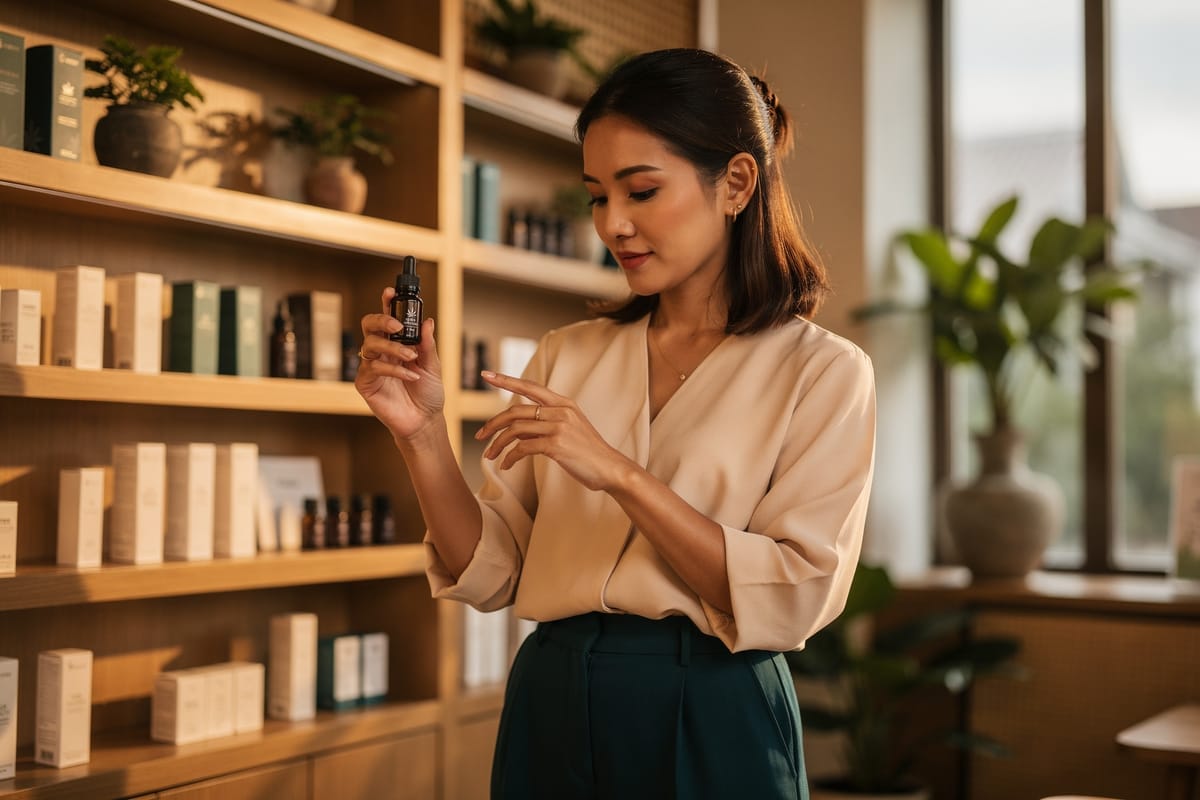
CBD (cannabidiol) is a non-intoxicating compound derived from cannabis and hemp plants. In Thailand, CBD products containing less than 0.2% THC are fully legal and do not require a prescription. Unlike cannabis flower, which now requires a PT 33 medical prescription following the June 2025 regulatory changes, CBD products remain freely available to both Thai nationals and tourists. You can purchase CBD oils, capsules, topicals, edibles, and beverages at pharmacies, wellness shops, online retailers, and even some convenience stores across the country. Thailand has become one of the most accessible CBD markets in Southeast Asia, with locally produced products alongside imported brands available nationwide.
CBD vs Cannabis in Thailand: The Legal Distinction
Understanding the difference between CBD products and cannabis products in Thailand is critical, because the legal treatment of these two categories is vastly different.
The 0.2% THC Threshold
The key dividing line in Thai law is the THC content of a product. THC (tetrahydrocannabinol) is the psychoactive compound in cannabis that produces a “high.” CBD (cannabidiol), by contrast, does not produce intoxication.
Under current Thai regulations:
- Below 0.2% THC: Products are classified as hemp-derived consumer goods. They are legal to manufacture, sell, purchase, and possess without any prescription or special license for the buyer.
- Above 0.2% THC: Products are classified as controlled substances. They require a PT 33 prescription issued by a licensed medical practitioner. Sales are restricted to licensed dispensaries with on-site medical supervision. For more on THC cannabis oils, see our cannabis oil guide.
This threshold applies to all product forms, including oils, tinctures, edibles, topicals, and beverages. A CBD oil with 0.15% THC is a consumer product. The same oil formulated with 1% THC requires a prescription.
What This Means Practically
For consumers, the practical implications are straightforward:
- You do not need to visit a doctor to buy CBD products under the 0.2% threshold.
- You do not need a PT 33 form or any other prescription document.
- You must be at least 20 years old to purchase CBD products in Thailand. This applies to all cannabis and hemp-derived products.
- Pregnant and breastfeeding women are prohibited from using cannabis and hemp products unless they have explicit medical authorization from a doctor.
- Products must be Thai FDA registered. Legitimate CBD products carry a registration number on their packaging.
The age restriction of 20 (not 18) is a common point of confusion for tourists. Thailand’s cannabis-related age limit is higher than the drinking age in many Western countries. Retailers are required to verify age before selling.
How Did We Get Here?
Thailand’s cannabis journey has been dramatic. In June 2022, Thailand became the first country in Asia to remove cannabis from its narcotics list. This led to a rapid proliferation of cannabis shops. However, by June 2025, the government reversed course on recreational cannabis, reclassifying cannabis flower as a “controlled herb” and requiring prescriptions for high-THC products. Throughout these changes, low-THC CBD products have consistently remained legal as consumer goods. The CBD market has been largely unaffected by the tightening of recreational cannabis rules.
What CBD Products Are Available in Thailand
Thailand’s CBD market has matured considerably since legalization. You will find a wide variety of product types across the country.
Oils and Tinctures
CBD oil is the most popular product format in Thailand. These are liquid extracts, typically suspended in a carrier oil such as MCT (coconut) oil or hemp seed oil. They come in glass bottles with droppers for sublingual (under the tongue) administration.
Concentrations typically range from 250mg to 3,000mg of CBD per bottle, with 500mg and 1,000mg being the most common. Some products specify concentration per milliliter (e.g., 33mg/mL) for easier dosing. Oils are available in natural (hemp), mint, citrus, and other flavored varieties.
Capsules and Softgels
CBD capsules offer pre-measured doses, making them convenient for people who want consistency without measuring drops. Capsules are typically available in 10mg, 25mg, and 50mg strengths. They are slower to take effect than sublingual oils (30-90 minutes vs. 15-30 minutes) because they pass through the digestive system first.
Topicals: Creams, Balms, and Salves
CBD topicals are applied directly to the skin and are popular for localized discomfort, joint stiffness, and skin conditions. Thailand’s tropical climate has made cooling CBD balms particularly popular. You will find CBD-infused versions of traditional Thai herbal balms, combining CBD with menthol, camphor, and Thai herbs like plai (Zingiber cassumunar).
Beverages
CBD-infused drinks are widely available in Thailand, from CBD coffee and tea to sparkling water and functional beverages. Many cafes in Bangkok, Chiang Mai, and tourist areas offer CBD as an add-on to smoothies or coffee drinks. Pre-packaged CBD beverages can be found in convenience stores and health food shops.
Edibles: Gummies, Chocolates, and More
CBD gummies are among the fastest-growing product categories. They come in various flavors and typically contain 10-25mg of CBD per piece. CBD chocolates, honey, and cooking oils are also available, though less common than gummies and beverages.
Skincare
CBD skincare products have established a strong niche in Thailand’s beauty market. Facial serums, moisturizers, body lotions, and lip balms infused with CBD are available at pharmacies and beauty retailers. These products typically emphasize CBD’s antioxidant and skin-soothing properties.
Thai Government Ganja Oil: What You Need to Know
One of the most distinctive aspects of Thailand’s cannabis landscape is the Government Pharmaceutical Organization (GPO) cannabis oil program. This government-produced product deserves special attention.
GPO Formulation Explained
The GPO (known in Thai as อภ. or Ongkan Phesatchakam) has developed and manufactured cannabis oil formulations that meet pharmaceutical-grade standards. These oils are produced from cannabis plants grown under controlled conditions at government-approved facilities, ensuring consistent cannabinoid profiles and freedom from contaminants.
The GPO initially developed three standardized cannabis oil formulations:
- CBD-dominant formula: Higher CBD content with minimal THC. This is the most widely distributed version and is used for general wellness, pain management, and anxiety.
- THC-dominant formula: Higher THC content, used primarily for severe nausea (particularly chemotherapy-related), appetite stimulation, and certain pain conditions. This formulation requires a prescription.
- Balanced CBD:THC formula (1:1 ratio): Equal parts CBD and THC, used for conditions where both cannabinoids are believed to work synergistically. This also requires a prescription.
Where to Get GPO Cannabis Oil
GPO cannabis oil is dispensed through the government hospital system. It is available at:
- Government hospitals with cannabis clinics (most provincial hospitals have one)
- Selected community health centers
- Some university hospitals
The CBD-dominant formula with less than 0.2% THC does not require a PT 33 prescription. However, accessing it through government hospitals typically involves a brief consultation with a practitioner, even though a prescription is not legally required for the CBD version.
The THC-containing formulas (THC-dominant and 1:1) require a PT 33 prescription and a documented medical condition.
Cost and Subsidized Pricing
One of the biggest advantages of GPO cannabis oil is its price. Because it is produced by the government and distributed through the public hospital system, it is significantly cheaper than commercial CBD products:
- GPO CBD oil: Approximately 100-500 THB per bottle, depending on the formulation and volume
- Commercial CBD oil (comparable quality): Typically 800-3,000 THB
For Thai nationals covered by the universal healthcare system (30-baht scheme), GPO cannabis oil may be available at minimal or no additional cost when prescribed for an approved condition. Foreign visitors can access GPO products at government hospitals but will pay the standard unsubsidized foreigner rate, which is still typically lower than commercial alternatives.
Conditions Treated with GPO Cannabis Oil
The GPO cannabis oils have been added to the National List of Essential Medicines (NLEM), meaning government hospitals can prescribe them for patients with qualifying conditions. These include:
- Cancer and chemotherapy-induced nausea and vomiting
- Neuropathic pain
- Epilepsy and seizure disorders
- Chronic pain
- Insomnia
- Multiple sclerosis and spasticity
- Parkinson’s disease
- Migraine
- Inflammation-related conditions
- Crohn’s disease
Note that the CBD-dominant formula does not require a diagnosis for any specific condition when purchased without a prescription.
How to Read Thai FDA Registration Numbers
Verifying that a CBD product is legitimate and properly registered with the Thai FDA is one of the most important steps you can take as a consumer.
What the Numbers Mean
All legally manufactured and sold CBD products in Thailand must carry a Thai FDA registration number. This number appears on the product packaging, typically on the back or bottom label.
The registration number is a 13-digit code that encodes information about the product category, manufacturing facility, and registration sequence. While the full decoding is complex, here are the key things to look for:
- The number should be 13 digits long and printed clearly on the packaging.
- The prefix indicates the product category. Different prefixes correspond to food products, cosmetics, herbal products, and medicines.
- The number should be verifiable on the Thai FDA website (oryor.com) using their product search function.
How to Verify a Product
To verify a CBD product’s registration:
- Locate the 13-digit registration number on the packaging. It may be labeled as “เลขที่จดแจ้ง” (notification number) or “เลขสารบบอาหาร” (food serial number) depending on the product category.
- Visit the Thai FDA website at oryor.com.
- Use the product search function and enter the registration number.
- The database will show the registered product name, manufacturer, and product details.
- Confirm the database entry matches the product in your hands.
Red Flags for Fake or Unregistered Products
Watch out for these warning signs:
- No registration number on the packaging. This is the biggest red flag. All legal products must display one.
- Registration number that does not verify on the Thai FDA website.
- No Thai language labeling. Products sold in Thailand must include Thai-language labels with ingredients, usage instructions, and warnings.
- Unrealistic CBD content claims. Products claiming extremely high CBD concentrations at suspiciously low prices should be treated with skepticism.
- No manufacturer information. Legitimate products list the manufacturer’s name and address.
- Missing THC content declaration. Legal CBD products must clearly state that they contain less than 0.2% THC.
- No expiration date. All registered products must display an expiration date.
- Imported products without Thai FDA registration. Even if a product is legitimate in another country, it must be separately registered with the Thai FDA for legal sale in Thailand.
Where to Buy CBD in Thailand
CBD products are available through multiple retail channels in Thailand.
Pharmacies
Pharmacies (ร้านขายยา) are one of the most reliable places to buy CBD products. Both chain pharmacies and independent pharmacies stock CBD oils, capsules, and topicals. Pharmacists can provide basic guidance on products and dosing. The advantage of buying at a pharmacy is the higher likelihood that products are properly registered and stored correctly.
Wellness Shops and CBD Specialty Stores
Dedicated CBD and wellness shops are common in Bangkok, Chiang Mai, Phuket, Pattaya, and other tourist areas. These shops typically offer a wider selection than pharmacies, including multiple brands, concentrations, and product types. Staff at dedicated CBD shops tend to be more knowledgeable about specific products and can help you compare options.
Be aware that following the January 2026 regulatory changes, many former cannabis dispensaries have either closed or pivoted to focus on CBD products. The shops that remain open must comply with updated licensing requirements.
Online Retailers
Online shopping for CBD is well-established in Thailand. Several domestic online retailers offer CBD products with delivery nationwide. Benefits of online shopping include a wider selection, the ability to compare prices, and access to detailed product information and lab reports. Most online retailers accept bank transfer, credit card, and some accept cash on delivery.
When buying online, verify that the retailer lists Thai FDA registration numbers for their products and provides Certificates of Analysis (COAs) from third-party labs.
Convenience Stores
Some convenience stores stock a limited selection of CBD products, typically CBD beverages and low-dose CBD gummies. The selection is narrow compared to specialty shops, but the accessibility is unmatched. You will find CBD drinks in many urban convenience stores.
Government Hospitals
For the GPO cannabis oil formula, government hospitals are the primary access point. As discussed above, the government-produced CBD oil is available at subsidized prices through the public hospital system. Most provincial hospitals and many community health centers stock GPO products.
CBD Dosage Guide for Common Conditions
Dosing CBD effectively requires understanding that there is no universal “correct” dose. Individual responses vary significantly based on body weight, metabolism, the condition being addressed, and the specific product being used.
General Starting Dosage Guidance
The widely recommended approach is “start low and go slow”:
- Starting dose: 5-10mg of CBD per day
- Assessment period: Use the starting dose for at least 5-7 days before increasing
- Incremental increase: If needed, increase by 5-10mg every 5-7 days
- Typical effective range: Most users find their effective dose somewhere between 10-50mg per day
Dosage by Condition
The following are general ranges reported in research literature and clinical practice. These are not medical prescriptions.
General Wellness and Daily Supplementation
- Range: 5-15mg per day
- Many users take a small dose in the morning or evening as part of their daily routine.
Pain Management
- Range: 15-50mg per day
- Some individuals with chronic pain use higher doses, but it is advisable to work up gradually and consult a healthcare provider for persistent pain.
Sleep Support
- Range: 15-50mg, taken 30-60 minutes before bedtime
- Some evidence suggests higher doses of CBD are more sedating than lower doses.
Stress and Anxiety
- Range: 10-40mg per day
- Can be taken as a single dose or split across the day. Sublingual oil tends to provide faster onset than capsules.
Skin Conditions (Topical Use)
- Apply CBD cream or balm directly to the affected area 1-3 times per day. Topical dosing is less precise and depends on the product’s concentration and the area being treated.
How to Titrate: Start Low, Go Slow
Titration is the process of gradually adjusting your dose to find what works best for you:
- Week 1: Begin with the lowest recommended dose for your goal (typically 5-10mg).
- Observe: Keep a simple journal noting what you took, when, and how you felt.
- Week 2: If you are not experiencing the desired effects, increase by 5-10mg.
- Repeat: Continue this process until you find your effective dose.
- Stability: Once you find a dose that works, maintain it consistently.
Most people find their effective dose within 2-4 weeks of this process.
Drug Interaction Warnings
CBD can interact with certain medications because it affects the cytochrome P450 enzyme system in the liver, which is responsible for metabolizing many drugs. Notable interactions include:
- Blood thinners (warfarin, heparin): CBD may increase the blood-thinning effect.
- Anti-epileptic drugs: CBD can alter blood levels of medications like clobazam and valproic acid.
- Blood pressure medications: CBD may enhance the blood-pressure-lowering effect.
- Immunosuppressants: CBD may affect the metabolism of drugs like cyclosporine and tacrolimus.
- Sedatives and sleep medications: CBD may increase drowsiness when combined with benzodiazepines or other sedatives.
- Certain antidepressants: Potential interactions with SSRIs and other psychiatric medications.
If you are taking any prescription medication, consult your doctor or pharmacist before using CBD products. This is not optional advice for people on medication — it is a safety necessity.
CBD for Tourists: What You Need to Know
Thailand is one of the easiest countries in Asia for tourists to access CBD products. Here is what visitors need to know.
Legal to Buy Freely
Tourists can purchase CBD products containing less than 0.2% THC without a prescription, without a Thai ID, and without any special documentation. Simply walk into a pharmacy or wellness shop, choose your product, and pay. You must be at least 20 years old.
What You Cannot Do
While buying CBD in Thailand is easy, there are limits:
- You cannot import CBD into Thailand. Even if your CBD oil is legal in your home country and contains less than 0.2% THC, bringing it into Thailand in your luggage is not permitted. Purchase locally instead.
- You cannot smoke or vape CBD in public areas where smoking is prohibited. Thailand has strict public smoking laws, and these apply to CBD vapes as well.
- You cannot purchase products above the 0.2% THC threshold without a PT 33 prescription. If you want higher-THC cannabis products, you will need to visit a licensed cannabis clinic and obtain a prescription first.
Airport and Customs Considerations When Leaving
This is perhaps the most important consideration for tourists. Taking CBD products out of Thailand is risky, regardless of their legal status in Thailand.
Here is why:
- Many countries classify all cannabis-derived products as controlled substances, including CBD.
- Airport security in your destination country may confiscate CBD products and potentially pursue legal action.
- Even if CBD is legal in your destination country, the product may not meet that country’s specific requirements for THC content, labeling, or registration.
- Transit countries may have their own restrictions.
Our recommendation: Consume your CBD products during your stay in Thailand. Do not attempt to carry them across international borders unless you have thoroughly researched and confirmed the legality in your destination country and any transit countries.
Hotel Rules
Most hotels in Thailand do not have specific policies about CBD products (as opposed to cannabis flower, which many hotels prohibit). However, some hotels, particularly international chain hotels, may have blanket policies against all cannabis-related products on their premises. If in doubt, ask the front desk before using CBD products in your room. Using CBD oil or capsules is discreet and unlikely to cause any issues, but CBD vaping may trigger smoke alarms or complaints from neighboring rooms.
How to Choose Quality CBD Products
Not all CBD products are created equal. Here is how to identify high-quality products in Thailand.
Third-Party Lab Testing (COAs)
A Certificate of Analysis (COA) is a lab report from an independent, third-party laboratory that verifies:
- The actual CBD content matches what is claimed on the label
- The THC content is below the legal threshold (0.2%)
- The product is free from contaminants including heavy metals, pesticides, residual solvents, and microbial organisms
Reputable brands make their COAs available either on the product packaging (via a QR code), on their website, or upon request. If a brand cannot or will not provide a COA, treat that as a significant red flag.
Full-Spectrum vs Isolate vs Broad-Spectrum
Understanding these terms will help you choose the right product:
-
Full-spectrum CBD contains CBD plus other naturally occurring cannabinoids (including trace amounts of THC, under 0.2%), terpenes, and flavonoids from the hemp plant. The theory behind full-spectrum products is the “entourage effect” — the idea that these compounds work better together than individually. Full-spectrum products will contain some THC, but legally must remain below 0.2%.
-
Broad-spectrum CBD is similar to full-spectrum but with THC removed (or reduced to non-detectable levels). This is a good option for people who want the potential benefits of multiple cannabinoids but are concerned about any THC content.
-
CBD isolate is pure CBD with no other cannabinoids, terpenes, or plant compounds. It is typically 99%+ pure CBD. Isolate products are the best choice for people who need to avoid THC entirely (for example, for drug testing purposes) or who want to know exactly how much CBD they are taking.
None of these is inherently “better” than the others. The best choice depends on your personal needs and preferences.
Extraction Methods
How CBD is extracted from the plant affects the quality and purity of the final product:
-
CO2 extraction is considered the gold standard. It uses pressurized carbon dioxide to pull CBD from the plant material, resulting in a clean, high-purity extract without toxic residual solvents. Products made with CO2 extraction tend to be more expensive but are generally higher quality.
-
Ethanol extraction uses food-grade ethanol as a solvent. It is effective and safe when done properly, though some terpenes may be lost in the process. This is a common method used by mid-range brands.
-
Hydrocarbon extraction (using butane or propane) can produce high-quality extracts but carries a risk of residual solvent contamination if not purged properly. This method is less common for CBD products in Thailand.
-
Oil infusion is a simple, traditional method where hemp is heated in a carrier oil. It is safe but generally produces less concentrated products.
Price vs Quality Indicators
CBD prices in Thailand vary widely. Here are guidelines for evaluating value:
-
Calculate cost per milligram of CBD. Divide the total price by the total CBD content in milligrams. This allows you to compare products of different sizes and concentrations on an equal basis. In Thailand, expect to pay roughly 1-5 THB per milligram of CBD for quality products.
-
Extremely cheap products warrant caution. If a product claims high CBD content at a price far below market rates, the actual CBD content may be lower than claimed, or the product may contain synthetic cannabinoids.
-
Premium pricing does not guarantee premium quality. Some brands charge high prices for marketing and branding rather than superior ingredients. Always verify claims with COAs.
-
Locally produced Thai CBD can offer good value compared to imported brands, as it avoids import duties and shipping costs. Several Thai manufacturers produce quality CBD oil from domestically grown hemp.
Potential Side Effects and Precautions
CBD is generally well-tolerated, but it is not without potential side effects. Being informed helps you use CBD safely.
Common Side Effects
Most side effects are mild and tend to occur at higher doses:
-
Drowsiness or fatigue: This is one of the most common effects, particularly at higher doses. It can be beneficial for people using CBD for sleep but may be unwanted during the day. If CBD makes you drowsy, avoid driving or operating machinery.
-
Dry mouth: CBD can reduce saliva production. Staying well-hydrated helps mitigate this effect.
-
Changes in appetite: Some people experience increased appetite, while others notice a decrease. This effect varies significantly between individuals.
-
Digestive changes: Diarrhea, nausea, or stomach discomfort can occur, particularly when starting CBD or increasing the dose. Taking CBD with food may reduce digestive side effects.
-
Lightheadedness: Some people experience a temporary drop in blood pressure after taking CBD, which can cause brief dizziness. This is more likely with higher doses.
-
Mood changes: While many people use CBD for anxiety and stress, a small number of individuals may experience increased irritability or mood changes.
Drug Interactions
As noted in the dosage section above, CBD interacts with the cytochrome P450 enzyme system. This means it can affect how your body processes many common medications. The “grapefruit test” is a useful rule of thumb: if your medication carries a warning about grapefruit interaction, it may also interact with CBD, as both affect similar metabolic pathways.
Always consult a healthcare provider before combining CBD with prescription medications.
When to Consult a Doctor
Seek medical advice before using CBD if you:
- Are taking prescription medications of any kind
- Are pregnant or breastfeeding (CBD use during pregnancy and breastfeeding is prohibited in Thailand without medical authorization)
- Have a liver condition (CBD is metabolized by the liver)
- Have low blood pressure
- Are scheduled for surgery (CBD may affect blood clotting)
- Have a history of substance use disorders
- Are under 20 years of age
Additionally, consult a doctor if you experience persistent or severe side effects from CBD use.
Not a Substitute for Medical Treatment
CBD is a wellness supplement, not a medicine. While research into CBD’s therapeutic potential is promising and ongoing, CBD products available without a prescription are not approved to treat, cure, or prevent any disease.
If you have a medical condition, CBD should complement — not replace — professional medical care. People with serious conditions such as epilepsy, chronic pain, cancer, or mental health disorders should work with a healthcare provider to develop a comprehensive treatment plan.
Frequently Asked Questions
Is CBD legal in Thailand in 2026?
Yes. CBD products containing less than 0.2% THC are legal in Thailand without a prescription. You can buy them at pharmacies, wellness shops, and online. The legal status of CBD has remained consistent even as Thailand has tightened regulations on higher-THC cannabis products. CBD is classified as a general consumer product when it meets the THC threshold requirement.
Do I need a prescription for CBD oil in Thailand?
No. Unlike cannabis flower or products with more than 0.2% THC, CBD products that meet the 0.2% THC threshold do not require a PT 33 prescription or any other medical documentation. You can walk into a shop and buy CBD products the same way you would buy vitamins or supplements.
What is Thai Government Ganja Oil?
Thai Government Ganja Oil is a cannabis oil formula developed and produced by the Government Pharmaceutical Organization (GPO). The GPO produces three formulations: CBD-dominant, THC-dominant, and a balanced 1:1 CBD:THC formula. These are manufactured under pharmaceutical-grade conditions and are dispensed through government hospitals. The CBD-dominant formula is available at subsidized prices, making it one of the most affordable CBD options in Thailand.
Can tourists buy CBD in Thailand?
Yes. Tourists can freely purchase CBD products with less than 0.2% THC from pharmacies, wellness shops, and convenience stores throughout Thailand. No Thai ID or prescription is required. The only requirement is that you must be at least 20 years old. However, be cautious about carrying CBD products out of Thailand, as many countries restrict CBD imports.
How much does CBD oil cost in Thailand?
CBD oil prices in Thailand range from approximately 500-3,000 THB for commercially available products, depending on the brand, concentration, volume, and quality. Government hospital CBD oil (GPO formula) is available from approximately 100-500 THB, making it significantly more affordable. When comparing prices, calculate the cost per milligram of CBD rather than comparing bottle prices, as concentrations vary widely.
Can I bring CBD oil out of Thailand?
You should exercise extreme caution. While CBD is legal to purchase and use in Thailand, many countries classify all cannabis-derived products as controlled substances, including low-THC CBD. Carrying CBD across international borders may result in confiscation, fines, or criminal charges in your destination country. Always research your destination’s specific laws before attempting to travel with CBD products.
What CBD products are available in Thailand?
Thailand offers a comprehensive range of CBD products including: oils and tinctures (the most popular format), capsules and softgels, topical creams and balms (including CBD-infused Thai herbal balms), beverages (coffee, tea, sparkling water), edibles (gummies, chocolates, honey), and skincare products (serums, moisturizers, lip balms). Both locally produced and imported brands are available.
How do I verify a CBD product is legitimate in Thailand?
Look for the Thai FDA registration number on the product packaging — it should be a 13-digit number. You can verify this number on the Thai FDA website (oryor.com) using their product search function. Legitimate products also display clear CBD and THC content on the label, include Thai-language labeling, list the manufacturer’s information, and have an expiration date. Be wary of products missing any of these elements.
This article is for informational purposes only and does not constitute medical advice. CBD products are not intended to diagnose, treat, cure, or prevent any disease. Always consult a qualified healthcare provider before starting any new supplement, particularly if you are taking prescription medications or have an existing health condition. While every effort has been made to ensure the accuracy of this information as of March 2026, regulations in Thailand can change. Always verify current requirements with official Thai government sources.
Frequently Asked Questions
Is CBD legal in Thailand in 2026?
Do I need a prescription for CBD oil in Thailand?
What is Thai Government Ganja Oil?
Can tourists buy CBD in Thailand?
How much does CBD oil cost in Thailand?
Can I bring CBD oil out of Thailand?
What CBD products are available in Thailand?
How do I verify a CBD product is legitimate in Thailand?
Cannabis for Thailand Editorial Team
Cannabis for Thailand