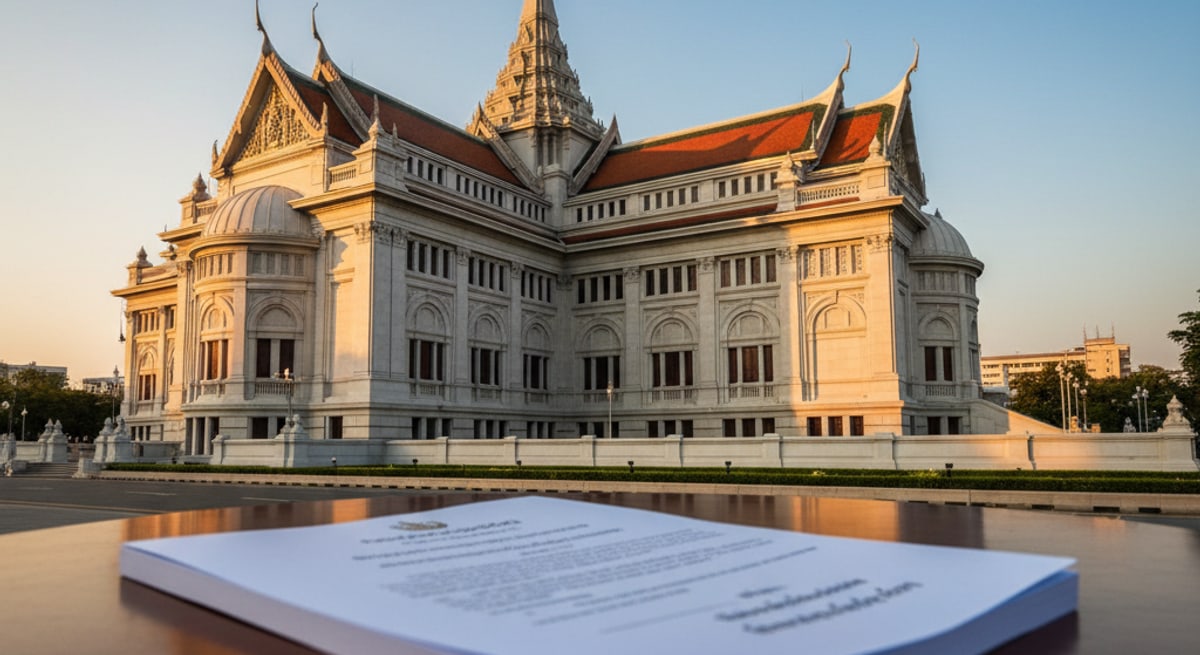
Thailand’s cannabis regulatory architecture is one bill short of being a coherent system. The bill in question — the Cannabis and Hemp Act (พ.ร.บ.กัญชา-กัญชง) — is currently in formal public consultation, with the comment window closing on 21 May 2026.
This is a live, time-sensitive piece of legislation. If you operate, prescribe, cultivate, or use cannabis in Thailand, the act’s final form will shape your regulatory environment for the rest of the decade.
Where Things Stand (As of 19 May 2026)
- Cabinet approval: 24 June 2025
- Current public consultation window: 22 April – 21 May 2026 (closes in 2 days)
- Ministerial sponsor: Public Health Minister Pattana Promphat
- Implementing department: Department of Thai Traditional and Alternative Medicine (DTAM)
- Next step: Parliamentary submission expected shortly after consultation closes
- Expected committee track: First reading → committee review → second and third readings
- Active alternative framework: Layered ministerial regulations (including the two new April 2026 regulations) continue to operate until parliament passes the act
Why a Single Statute Matters
The current legal framework for cannabis in Thailand sits across at least five different regulatory instruments:
- The Narcotics Code (covering extracts above 0.2% THC)
- The Protection and Promotion of Thai Traditional Medicine Knowledge Act B.E. 2542 (covering cannabis flower as a controlled herb)
- Ministerial Regulation B.E. 2569 on cannabis/hemp extracts (effective 26 April 2026)
- Ministerial Regulation (No. 2) B.E. 2569 on cannabis-flower commercial licensing (effective 30 April 2026)
- Multiple Ministry of Public Health notifications on advertising, prescribing professions, and dispensing rules
Operators describe this as “compliance archaeology” — you cannot determine your obligations from any single document. The act would consolidate the framework into one statute with subordinate implementing regulations.
What the Current Draft Would Establish
Per Ministry of Public Health communications during the consultation period and the 13 May 2026 update from The Active (Thai PBS), the draft act would:
Unified Licensing Authority
A single statutory body responsible for cannabis licensing, replacing the current split between FDA Thailand, DTAM, and provincial public health offices for different aspects of the supply chain.
Statutory Penalty Schedule
Penalty amounts would be codified in statute rather than living in ministerial notifications. This is operationally significant because statutory penalties are harder to adjust mid-cycle than ministerial penalties.
Codified Home Cultivation Rules
Minister Pattana Promphat publicly confirmed on 13 May 2026: “Home cultivation without sale is currently unpunishable; selling requires a licence.” The act would codify this — non-commercial home cultivation as a permitted activity, with sale gated by licensing.
Electronic Dispensing and Tracking
Mandatory monthly electronic dispensing reports and GPS-tracked licence verification. A government app is in development for licence and inspection verification.
Cultivation Registration and Tracking
Upstream cultivation registration — the act extends regulatory reach to growers, not just sellers. Cultivation is currently registered through the FDA’s Pluk Kan system; the act would consolidate this under the new unified authority.
Distribution Channel Specifications
Codification of where cannabis flower can be sold — extending the four-premises rule already in the ministerial framework (hospital, pharmacy, herbal products retailer, traditional healer workplace) into statute.
The Political Framing
Minister Pattana Promphat has been explicit about the policy direction in two public statements relevant to the act’s framing:
27 April 2026: Thailand’s direction “would focus on medical cannabis as a pathway towards a medical and health economy.”
13 May 2026: “The government has never had a free cannabis policy; supports medical use and economic benefits only.”
This framing matters. The 2022 decriminalization happened under a different political administration with a different framing. The current administration treats medical-only as the baseline direction, with the act formalizing rather than departing from that direction. Operators or investors hoping the act will reopen recreational access should not plan on that outcome.
Open Questions in the Current Draft
Several substantive questions are not fully settled as of the consultation period:
1. Foreign Ownership Outside Extracts
The 26 March 2026 extract regulation explicitly excludes foreign-owned businesses from production, import, and export of extracts above 0.2% THC. Whether the act extends or relaxes this exclusion for other parts of the supply chain (cultivation, retail dispensing, herbal product manufacturing) is not yet clear in public drafts.
2. Existing-Licence Treatment
The act will need transitional provisions for the licences already issued under the 2569 ministerial framework. The standard pattern is for existing licences to continue under the new statute, but whether they continue under the original criteria or get re-qualified at the next renewal under statutory criteria is still open.
3. Penalty Levels
Current penalties for cannabis-related offences range from administrative fines under ministerial orders to criminal penalties under the Narcotics Code. The act would consolidate these — what the consolidated levels look like for offences like sale without a licence, prescription without certification, or possession above prescribed quantities is one of the more contested clauses in the consultation.
4. Cannabis Tourism Treatment
The act does not appear to create a separate framework for tourist access; PT 33 remains the access mechanism. Whether the act constrains the tourist-pathway clinics that have grown up since 2022 is still being negotiated.
5. Advertising and Marketing
The blanket advertising ban from the 2025 ministerial notification (Article 9) is likely to be incorporated into the act, but the scope (educational content, dispensary directories, search results) has been a contested area in the consultation submissions.
Timeline From Here
| Event | Date | Status |
|---|---|---|
| Cabinet approval of draft act | 24 June 2025 | Complete |
| Public consultation opens | 22 April 2026 | Complete |
| Public consultation closes | 21 May 2026 | Imminent |
| Parliamentary submission | Late May / June 2026 | Expected |
| First reading | Q3 2026 | Expected |
| Committee review | Q3–Q4 2026 | Expected |
| Second and third readings | Q4 2026 – Q1 2027 | Expected |
| Royal Gazette publication | Subject to parliamentary process | Expected H1 2027 if no major obstacles |
These are expected timelines, not commitments. Thai parliamentary process is sensitive to coalition politics and competing legislative priorities. The act has been in some form of “moving toward passage” since 2022 — the consultation closure is a meaningful milestone but not a guarantee of imminent passage.
What Operators Should Do During the Consultation Window
Before 21 May 2026 closes, operators have one practical option: submit comments. The Ministry of Public Health accepts written submissions through its public consultation portal at law.go.th. The most useful comments address specific clauses with concrete operational language — generic support or opposition has less effect than detailed clause-by-clause input.
After 21 May 2026, the practical posture shifts to monitoring:
- Track committee-stage amendments through Royal Thai Gazette and parliamentary records
- Watch for ministerial communications signaling implementing regulations
- Maintain compliance with the existing ministerial framework — it remains the operating law until parliament passes the act
- Plan licence renewals against current criteria, not anticipated statutory criteria
Compliance Implications During the Transition
Until parliament passes the act and the implementing regulations are published, the existing framework remains the operating law. Operationally:
- The 26 March 2026 extract regulation continues in force
- The 30 April 2026 cannabis-flower licensing regulation continues in force
- PT 33 prescription requirements continue
- The DTAM guidelines published on 12 May 2026 remain authoritative
Operators should not delay compliance investments expecting the act to change the criteria. The most likely outcome is that the statutory criteria mirror the current ministerial criteria, with the framework consolidated rather than rewritten.
Why This Article Will Keep Updating
Cannabis legislation in Thailand moves on its own schedule. The consultation closing on 21 May 2026 is the next visible milestone, but the substantive content of the act can shift through committee review, and the practical timeline can stretch through political events outside the cannabis policy area.
This tracker is updated within 48 hours of any visible movement on the act — consultation closure, parliamentary readings, committee amendments, royal assent. For the consolidated regulatory picture as of May 2026, see our May 2026 law update. For the underlying ministerial framework, see our pillar law guide.
Related Reading
- What Changed? Thailand Cannabis Law Updates 2026 — full timeline pillar
- Thailand Cannabis Law Update: Two New Regulations Now in Force (May 2026) — the April 2026 regulations consolidated
- Ministerial Regulation No. 2 B.E. 2569 compliance guide — operator-facing detail on flower licensing
- Cannabis & Hemp Extract Regulation B.E. 2569 — operator-facing detail on extract licensing
- Cannabis Business Licence Thailand — licence types, costs, ownership rules
Frequently Asked Questions
What is the Cannabis and Hemp Act in Thailand?
When does the Cannabis and Hemp Act consultation close?
Will the Cannabis and Hemp Act legalize recreational cannabis again?
What happens to existing cannabis regulations if the act passes?
Will home cultivation be legal under the Cannabis and Hemp Act?
Cannabis for Thailand
Cannabis for Thailand