Cannabis and Traditional Thai Medicine: A Complete Guide
Cannabis and Thailand share a history that stretches back centuries. Long before the modern medical cannabis movement, Traditional Thai Medicine (TTM) practitioners were incorporating cannabis into multi-herb formulations to treat a range of conditions — from insomnia and pain to digestive disorders and muscle tension.
After decades of prohibition, that tradition is being revived. Licensed TTM practitioners are now among the professionals authorized to prescribe medical cannabis in Thailand, reconnecting modern patients with an ancient healing tradition.
This guide covers the full story: the history of cannabis in Thai medicine, how TTM practitioners prescribe it today, the traditional formulations being rediscovered, and the emerging research that is beginning to validate what Thai healers have known for generations.
Medical Disclaimer: This article is for informational purposes only and does not constitute medical advice. Always consult a licensed healthcare practitioner before using cannabis for any medical condition. Individual results may vary. Cannabis affects each person differently based on their constitution, dosage, and other factors.
The History of Cannabis in Thai Medicine
Centuries of Documented Use
Cannabis is not a newcomer to the Thai pharmacopoeia. Evidence of cannabis use in Thai traditional medicine dates back to the Ayutthaya period (1351–1767), one of the most prosperous eras in Siamese history. During the reign of King Narai the Great (1656–1688), cannabis was already documented as an ingredient in medical formulations used to treat various symptoms.
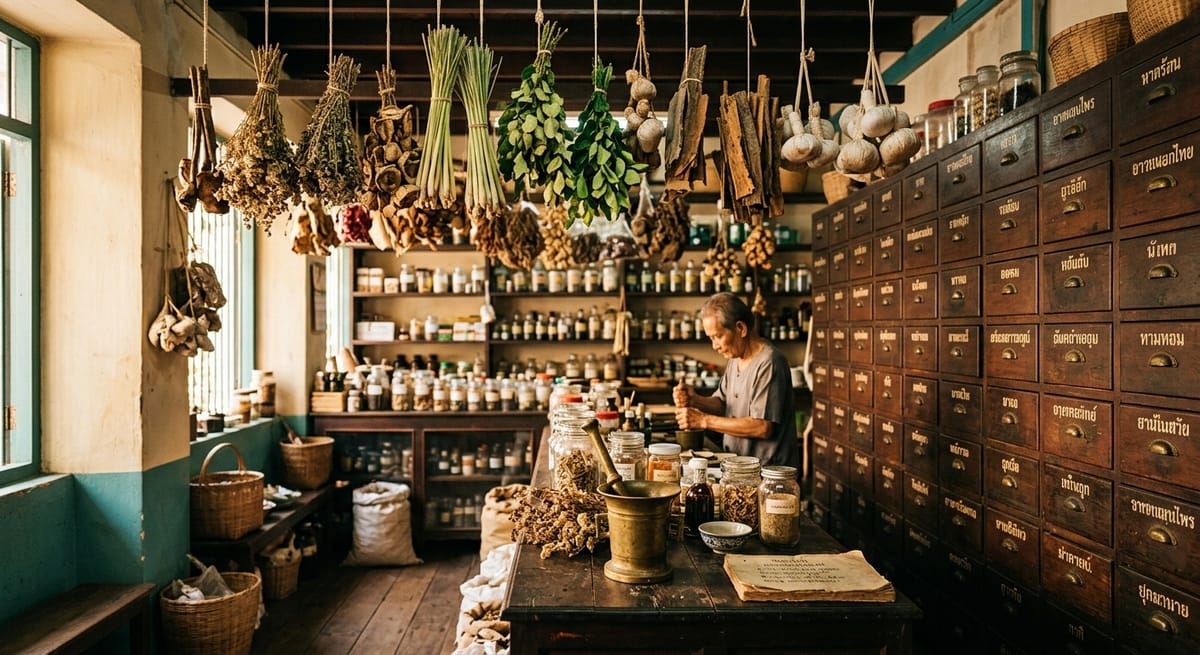
Thai traditional healers, known as mor phaen boran, utilized different parts of the cannabis plant — roots, stems, leaves, and flowers — each believed to carry distinct medicinal properties. Cannabis was rarely used in isolation. Instead, it appeared as one ingredient among many in carefully balanced herbal recipes, reflecting the TTM philosophy that healing comes from synergy between multiple natural compounds.
The Kampee Thart Phra Narai and Other Historical Texts
The most significant historical record of cannabis in Thai medicine is the Kampee Thart Phra Narai (ตำราพระนารายณ์), widely considered the first comprehensive Thai traditional medicine textbook. Compiled during King Narai’s reign, this text catalogs medicinal formulations of the era, and cannabis appears as a frequently recorded ingredient.
The text records multiple formulations that include cannabis alongside other Thai herbs — among them ยาศุขไสยาศน์ (Ya Sukhasaiyat), a cannabis-containing sleep formula that remains one of the 16 traditional cannabis formulas officially recognized by DTAM today. These were not recreational preparations; they were therapeutic recipes developed by court physicians and healers who served the royal household.
Beyond the Kampee Thart Phra Narai, cannabis appears in numerous other traditional medical manuscripts. Researchers from Siriraj Medical Bulletin have identified at least 26 cannabis-containing herbal recipes documented in Thai traditional medicine scriptures and textbooks. The Department of Thai Traditional and Alternative Medicine (DTAM) published a Thai-language textbook in 2021 titled “National Thai Traditional Remedies with Ganja” (ตำรับยาแผนไทยแห่งชาติที่มีกัญชาปรุงผสมอยู่), cataloging up to 162 remedies that include cannabis as an ingredient.
This is not a marginal tradition. Cannabis was woven deeply into the fabric of Thai healing practice.
Cannabis in the Thai Pharmacopoeia
In traditional Thai medical theory, cannabis was primarily understood as a medicine that addresses imbalances of the wind element (lom or ลม). Wind element abnormalities, in TTM theory, can manifest as insomnia, restlessness, muscle tension, certain types of pain, and digestive disturbances.
Cannabis flowers were the most commonly utilized part of the plant in traditional formulations, with research indicating they were used in approximately 85% of cannabis-containing recipes. Traditional practitioners appear to have recognized — centuries before modern cannabinoid science — that the flowering portions of the plant carried the most potent therapeutic properties.
Cannabis was never prescribed as a single drug in traditional practice. Thai medical texts consistently note that cannabis was combined with other herbs, partly to control its psychoactive effects and partly because TTM operates on the principle of synergistic multi-herb formulations. The nauseating taste of cannabis alone was another practical reason for combining it with complementary ingredients.
The Prohibition Period (1935–2018): What Was Lost
In 1935, Thailand passed the Cannabis Act, making the plant illegal. This legislation was influenced by international drug control pressures rather than by any Thai medical consensus that cannabis was dangerous. The prohibition was reinforced in 1979 when cannabis was classified as a Category 5 narcotic under Thailand’s Narcotics Act.
The consequences for traditional medicine were significant. Generations of TTM practitioners were cut off from an ingredient that had been central to their pharmacopoeia for centuries. Knowledge of cannabis-containing formulations was not entirely lost — it survived in historical texts and in the memories of elder practitioners — but the practical skill of preparing and prescribing these remedies atrophied during more than 80 years of prohibition.
Rural communities, where cannabis had been used in cooking and home remedies for generations, lost access to a plant that many families had grown alongside their other crops. The cultural connection between Thai people and cannabis was disrupted, though never fully severed.
Revival After 2018 Decriminalization
Thailand became the first Southeast Asian country to legalize medical cannabis in 2018. The initial legalization was narrow, but it opened the door for TTM practitioners to begin reconnecting with their tradition.
The period from 2018 to 2022 saw a gradual expansion of access. In June 2022, cannabis was briefly removed from the narcotics list entirely, creating a period of broad legalization. Then in June 2025, cannabis flowers were reclassified as a “controlled herb” under the Protection and Promotion of Thai Traditional Medicine Knowledge Act.
This regulatory framework is notable because it places cannabis under the jurisdiction of traditional medicine law rather than narcotics law. Cannabis is not classified as a narcotic; it is classified as a controlled herb — a distinction that reflects the Thai government’s recognition of the plant’s deep roots in traditional healing practice.
How TTM Practitioners Prescribe Cannabis Today
TTM Practitioner Licensing and Qualifications
In Thailand’s current regulatory framework, seven types of medical professionals are authorized to issue PT 33 (ใบสั่งยา ปท. 33) cannabis prescriptions. Licensed Traditional Thai Medicine practitioners are among them.
To become a licensed TTM practitioner, individuals typically complete formal education in traditional Thai medicine at accredited institutions, followed by licensing examinations. Some practitioners also learn through apprenticeship with established healers, though formal credentials are now required for cannabis prescription authority.
TTM practitioners who prescribe cannabis must be registered with the relevant regulatory body and comply with all documentation requirements, including the standardized PT 33 prescription form.
How the TTM Approach Differs from Western Medicine
The most fundamental difference between TTM cannabis prescriptions and Western medical cannabis lies in the diagnostic framework. Western medicine identifies specific conditions and targets them with specific cannabinoid profiles. TTM takes a more holistic view.
In TTM theory, health depends on the balance of four elements: earth (din), water (nam), wind (lom), and fire (fai). Disease arises when these elements fall out of balance. Cannabis is understood primarily as a medicine that addresses wind element disturbances, but a TTM practitioner will assess the patient’s overall elemental constitution before prescribing.
This means two patients presenting with the same symptom — say, insomnia — might receive different formulations based on their individual constitutional assessment. One patient’s insomnia might be diagnosed as a wind element disturbance, while another’s might be attributed to fire element excess, requiring a different therapeutic approach.
Holistic Assessment and Patient Constitution
A TTM consultation typically begins with a thorough assessment that goes beyond the presenting complaint. The practitioner may examine:
- Physical constitution — body type, skin quality, temperature tendencies
- Pulse diagnosis — TTM has its own pulse reading tradition, distinct from Traditional Chinese Medicine
- Dietary habits — food choices are central to TTM theory
- Sleep patterns and daily routine — disruptions in routine are diagnostically significant
- Emotional state — mental health is not separated from physical health in TTM
- Seasonal factors — the time of year and weather conditions influence treatment decisions
Based on this assessment, the practitioner determines which formulation is most appropriate. Cannabis may or may not be part of the recommended treatment.
Cannabis as Part of Multi-Herb Formulations
True to traditional practice, TTM practitioners today often prescribe cannabis as one component of a multi-herb formulation rather than as an isolated medicine. This approach has several rationale:
- Synergy — Other herbs may enhance or modulate the effects of cannabis
- Side effect management — Complementary herbs can offset unwanted effects
- Targeted action — The overall formulation can be tailored to the individual patient
- Cultural continuity — This is how cannabis has been used in Thai medicine for centuries
That said, the modern regulatory framework does allow TTM practitioners to prescribe cannabis flower directly under the PT 33 system, and some practitioners do so when they judge it appropriate.
Common Conditions Treated
TTM practitioners most commonly prescribe cannabis-containing formulations for:
- Insomnia and sleep disorders — Cannabis’s effects on sleep are among the most well-documented in both traditional and modern literature
- Chronic pain — Particularly musculoskeletal pain and tension
- Muscle spasms and tension — Often treated with topical cannabis preparations
- Digestive disturbances — Especially those attributed to wind element imbalance
- Appetite loss — Cannabis’s appetite-stimulating properties are recognized in both TTM and Western medicine
- Anxiety and restlessness — Viewed through the lens of wind element excess in TTM theory
- General wellness and constitutional balancing — A concept without a direct Western medical equivalent
Traditional Cannabis Formulations
Historical Recipes and Modern Adaptations
Of the 162 traditional remedies cataloged by DTAM, eight have been incorporated into the approved list by Thailand’s Ministry of Public Health. These approved formulations have undergone at least basic standardization to ensure consistency in preparation and dosing.
Traditional recipes often called for specific parts of the cannabis plant combined with carefully measured quantities of other Thai herbs. Modern adaptations maintain the ingredient combinations but may use standardized extracts rather than raw plant material, improving consistency and enabling more precise dosing.
Balms and Topical Preparations
Cannabis-infused balms (ya mong or ยาหม่อง) and compresses (luk prakop or ลูกประคบ) represent some of the most widely used traditional cannabis preparations. These topical applications have been part of Thai massage (nuad boran) and therapeutic bodywork for centuries.
Traditional cannabis balms typically combine cannabis with ingredients such as:
- Camphor
- Menthol
- Turmeric
- Ginger
- Phlai (Zingiber montanum)
- Various essential oils
These preparations are used for muscle pain, joint stiffness, inflammation, and general soreness. The Government Pharmaceutical Organization (GPO) has developed standardized versions of several traditional topical formulations.
Oral Preparations
Traditional oral cannabis preparations include decoctions (boiled herbal mixtures), tinctures, and combinations with food. One well-known category involves cannabis formulations designed to address wind element disorders, which would include conditions modern medicine might classify as insomnia, anxiety, or certain digestive complaints.
The Suk Sai-Yad formula, studied at Chao Phya Abhaibhubejhr Hospital, is an example of a traditional oral preparation that has been subjected to modern clinical evaluation. This formula combines cannabis with other herbs and has been used traditionally for chronic insomnia.
The GPO’s Traditional Formula Development
The Government Pharmaceutical Organization (GPO) has played a central role in bridging traditional formulations with modern pharmaceutical standards. The GPO has developed several cannabis products based on traditional recipes, applying modern quality control measures while maintaining the multi-herb approach characteristic of TTM.
These products are manufactured under pharmaceutical-grade conditions and are available through authorized dispensaries. The GPO’s involvement lends institutional credibility to traditional formulations and provides practitioners with standardized products they can prescribe with greater confidence in consistency and dosing.
Research: Thai Traditional Medicine Meets Modern Science
The Phase II Insomnia Trial
One of the most significant pieces of research validating traditional Thai cannabis medicine is a Phase II randomized, double-blind, active-controlled non-inferiority trial published in the Journal of Cannabis Research (Springer Nature) in early 2026.
The study, conducted by researchers from Suan Sunandha Rajabhat University and Mahidol University, compared a traditional Thai cannabis-based herbal formulation — the Anti-Pom-Leung Fever medicine — against lorazepam (a benzodiazepine commonly prescribed for insomnia) over a four-week period.
Key findings from the trial of 100 participants:
- The herbal formulation group achieved a mean Pittsburgh Sleep Quality Index (PSQI) score of 3.44, compared to 4.78 in the lorazepam group
- The mean difference of -1.34 met the study’s predefined criteria for non-inferiority, meaning the herbal treatment performed at least as well as the prescription sleep medication
- Quality of life and stress measures improved in both groups
- No clinically significant adverse effects were reported with the herbal formulation
- Laboratory and clinical assessments indicated the herbal formulation was well tolerated
This is noteworthy because it suggests that a traditional multi-herb cannabis formulation can match the performance of a widely prescribed pharmaceutical for insomnia — without the dependency risks associated with benzodiazepines. However, it should be noted that this is a single Phase II trial with a relatively small sample size, and larger confirmatory studies are needed.
Additional Research
A separate study published in ScienceDirect examined integrative therapies for chronic insomnia, including a randomized controlled trial of a traditional Thai herbal remedy combined with Cannabis sativa oil. These studies represent a growing body of research examining traditional Thai formulations through the lens of modern clinical methodology.
Research from the Siriraj Medical Bulletin has analyzed the use of cannabis-containing herbal recipes in Thai traditional medicine manuscripts, providing important ethnopharmacological documentation. A qualitative ethnopharmacological analysis published in the Tropical Journal of Natural Product Research has further examined cannabis-based formulations for insomnia in TTM recipes.
Thai Government Research Programs
The Thai government has invested significantly in cannabis research, with several institutions conducting studies on traditional formulations:
- Chao Phya Abhaibhubejhr Hospital — Has conducted preliminary studies on the Suk Sai-Yad herbal remedy for chronic insomnia
- The Department of Thai Traditional and Alternative Medicine (DTAM) — Coordinates research on traditional cannabis formulations
- Multiple Thai universities — Including Mahidol University, Chulalongkorn University, and Suan Sunandha Rajabhat University
Evidence Gaps and Ongoing Studies
Despite the encouraging early results, significant gaps in the evidence base remain. Most traditional cannabis formulations have not undergone rigorous clinical trials. The multi-herb nature of TTM formulations makes them more complex to study than single-compound medicines, as researchers must account for interactions between multiple active ingredients.
Areas where more research is needed include:
- Long-term safety profiles of traditional cannabis formulations
- Optimal dosing ranges for different traditional preparations
- Head-to-head comparisons between traditional multi-herb approaches and single-cannabinoid treatments
- Standardization of traditional formulations for research reproducibility
- Mechanism of action studies explaining how traditional combinations work
Finding a TTM Cannabis Practitioner
How to Verify Credentials
Not all TTM practitioners are authorized to prescribe cannabis. To verify credentials:
- Ask for their license number — All licensed TTM practitioners should have a verifiable registration
- Check with the Thai Traditional Medical Council — This body oversees TTM practitioner licensing
- Confirm PT 33 authorization — Not all TTM practitioners have completed the additional requirements for cannabis prescription authority
- Look for institutional affiliation — Practitioners at government hospitals or accredited clinics are more likely to have proper credentials
What to Expect at a TTM Consultation
A typical TTM cannabis consultation involves:
- Initial assessment (30–60 minutes) — The practitioner will take a thorough health history and conduct a constitutional assessment
- Diagnosis — Using TTM diagnostic frameworks (element theory, pulse diagnosis, physical examination)
- Treatment plan — Which may or may not include cannabis, depending on the assessment
- Prescription — If cannabis is prescribed, the practitioner completes the PT 33 form
- Follow-up — Many practitioners schedule follow-up visits to monitor response and adjust the treatment plan
Patients who are accustomed to the brief consultations typical of Western medicine may find the TTM approach refreshingly thorough. The longer consultation time reflects the holistic diagnostic process.
Cost Ranges
Costs for TTM cannabis consultations vary depending on the setting:
- Government TTM clinics — Generally the most affordable option, sometimes free or low-cost for Thai nationals
- Government hospital TTM departments — Moderate cost, often covered by Thai health insurance schemes
- Private TTM clinics — Higher cost, but may offer more personalized attention and shorter wait times
- Tourist-oriented clinics — Typically the most expensive, but often provide English-language service
The PT 33 prescription itself is subject to standard fees. Cannabis products purchased with the prescription are priced separately.
Government vs. Private TTM Clinics
Government TTM clinics offer several advantages: lower costs, practitioners vetted through institutional hiring processes, and access to GPO-manufactured standardized cannabis products. The tradeoff is potentially longer wait times and less flexibility in scheduling.
Private TTM clinics may offer more convenient scheduling, longer consultation times, and a wider selection of cannabis products. However, patients should exercise due diligence in verifying the practitioner’s credentials and the quality of products offered.
Finding a Clinic
For help locating a licensed TTM practitioner who can prescribe cannabis, consult our clinic finder or review our guide to getting a PT 33 prescription.
The Cultural Significance of Cannabis in Thai Life
Cannabis in Rural Thai Communities
Before prohibition, cannabis was a familiar plant in rural Thailand. It grew in home gardens alongside other herbs and vegetables. Farm families used it in home remedies — a poultice for sore muscles after a day in the fields, a preparation to help with sleep, a digestive aid.
This was not considered drug use. It was simply part of the rural Thai pharmacopoeia, as unremarkable as using ginger for nausea or turmeric for inflammation. The 1935 Cannabis Act disrupted this tradition, but it did not erase the cultural memory entirely.
Cannabis in Thai Cooking Traditions
Cannabis leaves have traditionally appeared in Thai cuisine, most famously as an ingredient in certain regional variations of boat noodles (kuay tiew reua) and some curry preparations. The leaves were valued for their flavor and aroma as much as for any psychoactive properties, which are minimal when cannabis leaf (rather than flower) is used in cooking.
After the 2022 decriminalization, cannabis leaves appeared in restaurant dishes and beverages across Thailand. While the 2025 regulatory changes restricted cannabis flower to prescription-only status, cannabis leaves with low THC content remain available for culinary use under certain conditions.
Cultural Attitudes Toward Medical Cannabis
Thai attitudes toward medical cannabis are generally positive. Public opinion surveys have consistently shown strong support for medical cannabis access. This support is rooted partly in the cultural memory of traditional cannabis use and partly in the practical observation that cannabis-based medicines can help with common conditions.
The framing of cannabis within the TTM tradition has been politically and culturally important. By positioning cannabis as a controlled herb under traditional medicine law rather than as a narcotic, the Thai government has created a regulatory framework that respects the plant’s cultural heritage while maintaining appropriate controls.
The Future of TTM and Cannabis Integration
The integration of cannabis into modern TTM practice represents a broader trend in Thai healthcare: the recognition that traditional and modern medical approaches can complement each other. Several Thai hospitals now maintain both TTM and conventional medicine departments, and patients may be referred between them.
For cannabis specifically, the trajectory appears to be toward greater research validation of traditional formulations, continued standardization of products, and expansion of the evidence base through clinical trials. The Phase II insomnia trial discussed above may be the first of many studies that examine traditional Thai cannabis preparations using modern scientific methodology.
As this research progresses, TTM cannabis practice has the potential to contribute knowledge that benefits not only Thai patients but the global understanding of how cannabis can be used therapeutically within holistic medical frameworks.
This article was last updated on March 27, 2026. Cannabis regulations in Thailand are subject to change. Always verify current requirements with a licensed practitioner or official government source.
Cannabis for Thailand provides informational content and does not sell cannabis products. We are not medical professionals. Consult a licensed TTM practitioner or physician before beginning any cannabis-based treatment.
More on medical cannabis in Thailand: start with the pillar guide to medical cannabis in Thailand for the legal status, costs and access routes, and the PT 33 prescription guide for the form itself.
Frequently Asked Questions
How long has cannabis been used in Thai medicine?
Can TTM practitioners prescribe cannabis in Thailand?
How does TTM cannabis differ from Western medical cannabis?
What conditions do TTM practitioners treat with cannabis?
Cannabis for Thailand Editorial Team
Cannabis for Thailand